Final Course Reflection

I believe the most important aspect of what we have looked at this semester is policy.

Looking at trends, you see what people are jumping on board with. Trends, by definition, are fleeting, and can change rapidly. It is important to know these factors if you are working in the technology fields, but if you are just an average consumer, you will be exposed to the trends that are important to you by way of your social circle.

Understanding how to evaluate technology using the various theoretical approaches can be useful, but as a math major, I very much prefer to not work in the realm of the theoretical. It’s not that I don’t understand the value of a theoretical evaluation, but I am not a technology major, so I will not need to know them moving forward.

Social issues are also important. In fact, it was a tie between social issues and policy for me on which was more important. It is important to see how the way we interact with each other socially is evolving, almost daily, because of technology. We rarely talk to each other anymore. There is a well-traveled joke among the members of my generation about sending a meme to someone in the room with you, and waiting for them to see it. We know that you WILL check your phone at the slightest vibration. In the wake of this, you also have a movement to put the phones down. My fiancé and I have established a date night rule: the phone stays in the car. {Note: I am the worst offender in the relationship with my fiancé of not being in the moment, so I have instituted this rule.}

It is important to see the way technology has impacted our social-political climate. In the era of #fakenews, we have an ever widening distrust of our fellow man, not just mass media. There was a time, not that long ago, when people could disagree peacefully, because we attributed someone being wrong to simply having misinformation. Now, we are convinced that someone who has posted something that is incorrect, no matter how insignificant, is deliberately trying to deceive us or subvert the rule of law. Literally every single comment thread I see about politics has multiple “That’s just a bot” comments in response to someone disagreeing with them, but then you click the so-called-bots profile, and it has all the indicators of a real person (like an account established 6 yeas ago).  Now, every relationship is cannon fodder for the march toward the individuals political party domination. My family had a cousin that erased every other member of the family from their facebook page, and completely cut off contact after the 2016 election. Why? Because the media had been convincing everyone for so long that the outcome was guaranteed, and some of us could not handle being disappointed. These issues are heightened by all media, from the smallest blog on gun rights, to the prime time talk shows on CNN/FOX/MSNBC/etc. Everyone wants to get in on spreading the next social issue to their followers, and unfortunately it is so often, intentionally or not, skewed to push people to make extreme decisions.

Finally we arrive at policy. I feel that this is the most important factor discussed in this class, because it has the most long-lasting impact. Social issues can fade in a week, but a policy decision can last for years. When you have these policy decisions being made about technology, we can all suffer. What happens if the government decides tomorrow that Facebook needs to be shut down for some reason? What if the government decides that everyone in the country needs to pay an additional tax for the right to use a smartphone? Those are scary sounding suggestions. Understanding the way the government makes policy when it comes to technology brings an understanding that we can rest easy knowing we would see changes like that coming from a mile away, and could take appropriate action to prevent them from being imposed.

Fear Of Merriment Overload

I personally cannot think of too much extreme FOMO that I have had for experiences. I actually very much prefer to be home, and am quite introverted if given the choice when it comes to public settings. Of course, in classroom settings where participation is required, I am able to get past that part of myself.

I think the best example I can give is with board games. I love board games, and when I get a board game, I like to get ALL of the board game. If there are expansions for the game, I want to have all of them. I actually just recently decided to NOT buy Carcassonne, because I looked up how many expansions their were, and realized that I would have anxiety over not having all of them, even if I hardly ever played any of them.

I also hardly ever am in the mood to play Settlers of Catan on my personal copy of the game, because I don’t have the several expansions that are available. I actually love Catan, and will play when my friends bring it out at their houses.

One of my favorite games of all time, Dominion, had an expansion the was recently released, and I have been forcing myself to not buy it, because while in school, I have not been playing the game enough to justify getting the expansion at this time.

I am getting married in June, and I was looking all over for something I could get my groomsmen as gifts. I found a print-and-play game, where you pay $0.99 once and get the PDF, and then can make as many as you want. It seemed like a fun game that I would love, and so I decided “I am going to buy the full set of this game (like 20 different PDFs of different components) and print off a full copy for each of my groomsmen”. Note: I m going to give my groomsmen the link, and tell them that if they want to have more, they have to buy the game themselves.

My buddy convinced me to make a character and play Dungeons and Dragons with him. I loved it, and within 2 days, I had the beginnings of a novels worth of backstory for my character. I almost bought a complete set of the newest D&D books (like $200 worth of books) simply because I was thinking “I should really get into this!” That buddy is the only person I know who plays D&D, aside from the people he brought to the game. Luckily, I realized that before forking over the cash.

For me, FOMO is not about big events, it is about table top and board games. I also think my love of board games is, at this point, qualifying as a minor addiction (I say minor because I am able to deny myself, and I would never do anything illegal to feed it). This blog assignment has actually been immensely helpful, and I think I know some areas I need to be more mindful of my approach to boardgames.

Digitally Divided

The foremost reason to care about the digital divide in the United States is that the internet is no longer optional. So much of what we do is conducted online.

There are business that do not even accept a paper application anymore.

There are banks that do not have brick-and-mortar locations anymore.

There are schools that are significantly more affordable than the average cost of tuition in the US, and they are totally online.

Far too often, people are excluded from participating in something that would drastically improve their future, simply because the digital divide is alive and well. When people cannot take steps to better their future, they begin to lose hope, and a hopeless society is a society that gives rise tremendous atrocities visited on minorities. Let us not forget that Germany elected Hitler legally, because there was a divide caused by people not being able to take steps towards a better future.

I think the crux of this issue lies with the questions: who is responsible to end the digital divide? My answer to that is schools. Increasingly, schools are embracing online homework, or homework that is online research heavy. This makes me feel like it is their responsibility to make sure their students are actually capable of doing that homework.

This would end up being a widespread government program, and as a libertarian on most issues, I often hesitate to accept government intervention in the personal lives of citizens. However, this government program would give people the tools they need to get out of poverty, and that is a noble goal that should be embraced and promoted. For all we know, the next Stephen Hawking is sitting in some school failing his science class because he doesn’t have internet at home.

Granted, it would be spectacular if private business took this goal on, and ran with it, but it is unrealistic to expect a private business to give away everything for free, even if they got tremendous tax-breaks. The only possible way I could see for private business to be involved would be if the government simply bought their service for whole towns. Maybe start small and have the government buy wifi for the 10 poorest towns in every state in the nation. That alone would be a tremendous step on the right direction.

Musical Foreshadowing

I believe the future of the music industry is streaming.

In the Global Recorded Music Industry Revenues 1999-2017 chart, Steaming and Performance Rights are the only two areas that have shown consistent growth since their introduction. In fact, most other areas are actually showing less revenue in comparison. As someone who does not subscribe to music streaming services outside of what is included with my Amazon Prime membership, I believe this speaks to the effectiveness and appeal of streaming services. I have friends who have said that they cut spending in other areas of their entertainment consumption lives because they could not live without the ad-free version of Pandora/Spotify.

We want specific music, but we don’t want to pay for the song to keep forever, because we recognize that we have differing tastes as time goes on. I myself have songs that I bought on iTunes as a teenager because “I love this song!” But I have not listened to them in ten years.

I also think of the facebook live phenomena that is taking over my generation and younger. It is a very real possibility, that my generation will embrace a virtual concert, where the artist streams their “live” performance, and people who can’t be there can enjoy it. You could set-up a payment system where a cheaper “ticket” gets access to a single camera in the back of the venue, a middle-expense ticket gets access to the close-up cameras on the performer, and the most expensive tickets actually allow you to be physically there. You could even have an additional expense where people can stream from their personal device through the app, and others with the app can pay to unlock that perspective. People could build a social following for being someone who goes to these events, and maybe they get a small cut of the profits generated by their personal stream.

The problem with streaming an event that tickets have been sold for is that people who didn’t pay get to experience the event can get some of the exclusive content that is being shared at the event. I think this weakness will be exploited by the music industry before too long, and then of course there is the expansion into other industries where live events have exclusive content, like comic-con.

Photo Manipulation

Yes, I do think it would be a good thing if every photo that was retouched or edited in some way was labeled as such.

I am fairly libertarian, so I do not believe the government should make a law, but the people making these photos should be conscious of the incredible harm their photos can do. There has been a strong and positive discussion about the effects on self esteem, or mental health that photoshopped images can have. The fact that images that have been heavily retouched are still not labeled as such by the people publishing them, just goes to show how incredibly the benefits of retouching an image to suit an agenda has become ensconced in the mass media.

Video Games

I think it is important, when talking about this issue, to remember that it is possible to create computer games that are actually inclusive to everyone, and have no possible bias in the actual play material. An example of this is M.E.N.A.C.E., or Machine Educable Noughts and Crosses Engine. It is a “manual computer” which means that it is not a digital computer. It is actually a pile of matchboxes with colored beads, that will learn how to play tic-tac-toe (noughts and crosses in England). Now, this is technically a “cheat” when talking about “computer” games, but I personally prefer face-to-face tabletop games myself, so that is why I begin here. I also don’t have loads of experience with traditional “video games.” I will include a link to an article about M.E.N.A.C.E. if you want more info. I will also include another link to an article about other types of “matchbox game learning machines”.

http://chalkdustmagazine.com/features/menace-machine-educable-noughts-crosses-engine/

http://www.mscroggs.co.uk/blog/52

Now, into the realm of “video games” in the most commonly thought of sense.

I think something to consider when dealing with the issue of diversity in video games, specifically in the development of games and hardware, is that every person is a collection of unique experiences. I think the best way to illustrate what I mean is to share a story.

I was once standing in the hallway outside a mentors office, and he asked me “From where you are standing, what is the first book on the shelf?” When I answered he said “Ah, but I can see the real first book on the shelf, and there are 4 books being hidden from your view. Just as you can see the true last book on the shelf, and I have books hidden from my view.”

We all, because of where we are approaching a problem from, have different blindspots. Having a team that is diverse in many ways, is the best way to insure that your own ignorance is not causing you to have a major blindspot. Not to be too cynically capitalistic, but these blindspots can cause massive losses in revenue. To be honest, it is funny to me that companies are not more actively pursuing diversity for diversities sake, even to the point of starting scholarships to send minority High School students to tech colleges to learn code. Like, why is there not a $2 million “Nintendo Diversity Scholarship” that is being actively promoted?

I also see huge potential for hardware development to be more inclusive to people with disabilities. I loved the “co-pilot” development. That is an amazing option, and I think it being popular in the community of kids with disabilities will help drive more development in this area. I also think there are a lot of stories you could tell through the medium of video games that explore what it is like to live with a disability.

Beginning Research

Rosenberg, A., & Rosenberg, A. (2018, January 24). Virtual reality’s moment looks to be over in gaming, at least for now. Retrieved February 22, 2019, from https://mashable.com/2018/01/24/virtual-reality-gaming-loser-gdc-2018-survey/#wbn67R1Fz5qC

This article looks at the problems that VR has faced, because it has not had significant buy-in from consumers. It postulates that the future of VR technology is going to be in training or education, like healthcare. It also distinguishes that AR (augmented reality) has found success because it is on your phone, and easy to participate in, like Pokemon Go.

VR Gaming and the Technology’s Impact on the World. (2018, October 15). Retrieved February 22, 2019, from https://www.headstuff.org/entertainment/gaming/vr-technology-and-the-gaming-world/

This article looked at the potential for VR, given that AR is so popular. It took the stance that 3D printing technology has made it easier to create customized headsets, which makes them more readily available to consumers, because a company is able to make a branded VR headset for cheap, and include it with some other product. It postulates that the future of VR is similar to the holo-deck from Star Trek.

Internet of Things

            Via a cursory glance through the chapters, the technology advancement that stood out to me most is from chapter twelve: Internet of Things.

            The reason that concept caught my eye is that I enjoy my personal gadgets to all communicate with each other. That is a big reason I have mostly all apple products: they all communicate with each other easily.

            The interesting advancements in this tech for me will be when the only gadgets you can buy are connected devices. An example of that would be the shrinking pool of televisions that are not smart. Of course, there are major privacy concerns with having everything be connected, and while I do value privacy, I also understand that when I downloaded facebook on my phone, knowing full well they listen to everything to target ads, I gave up any claim to privacy I may have once had. I also understand that the government is already tracking everything anyway, so why pretend that we have any privacy left?

            Something that would also, in my mind, be considered part of the IoT is the “Next Gen” tv, that has the ability to stream straight to your phone. That is an amazing idea, and I actually left class that day and looked it up. I think it is a fascinating thing that in todays world, everyone has a super-computer better than the computer we used to get to the moon in their pocket, AND it is connected to the entirety of human accumulated knowledge. I think that has been a crucial step toward the IoT, because we are all already connected in that way, so having all of our tech also connected in every way is the next logical step.

            A huge problem that I can foresee, is that all that connected tech we have is still dependent on being plugged into electricity, and massive power outages could cause loads of problems if the tech has to be all reconfigured if it loses power.

History in Photos

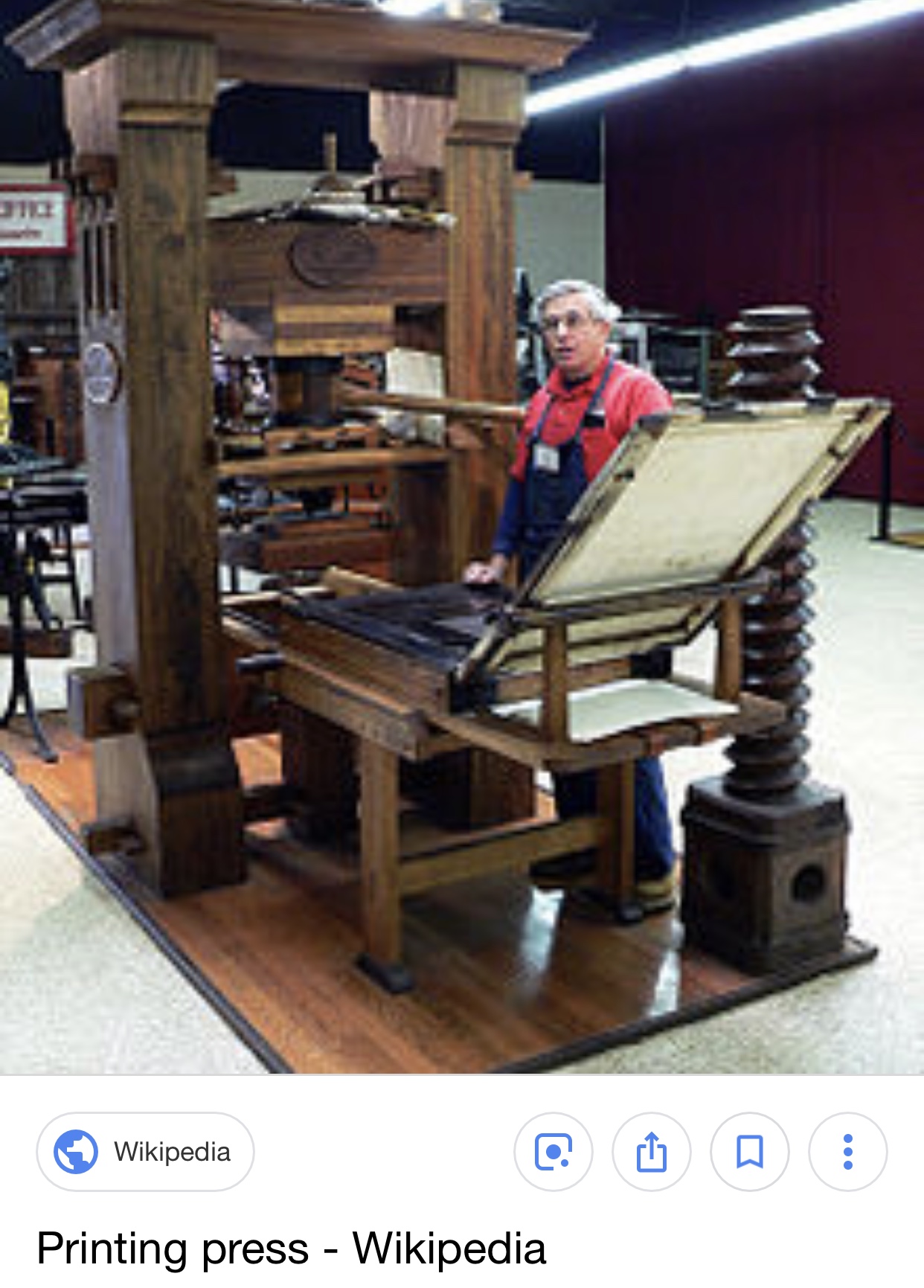
I chose to do the history of the printer/copier. Each photo was found using a google image search, and each one has the name of the website it is an image from.

The picture is recent, but the tech was prevalent until about the mid-1400’s for copying whole works.
The press was invented around the mid 1400’s
This was an early model printer from the 1950’s
This was common design from around the 1990’s.
This is a machine that does it all, and it is being manufactured and sold today.